
Last updated:
As an Amazon Associate, IronsExpert earns from qualifying purchases. If you buy through links on this page we may earn a commission, at no extra cost to you. It never affects which products we recommend. How we research.
Quick answer: iron trousers in this order: pockets and waistband, then the seat and the top of the legs, then one leg at a time with the inseams lined up on top of each other. Lining up the inseams is what puts the crease in the right place. Press the crease by lowering the iron, lifting it and moving along, rather than sliding it. Suit trousers get a front and back crease that stops at the bottom of the pocket bags; chinos get a softer one or none; jeans are ironed flat with no crease. Use a pressing cloth on wool, and hang the trousers to cool before you wear them.
A good iron for trousers
- Best steam iron for creases Russell Hobbs Powersteam Ultra 20630 (£). Check price
How we chose these picks
We compared the manufacturers’ published specifications, independent UK tests and reviews (including Which?: 10 ironing tips to get clothes looking their best, Which?: How to iron, Art of Manliness: How to Iron Trousers, Gentleman's Gazette: How to Iron Dress Pants), and recurring themes in verified owner reviews. We checked that every product was on sale in the UK when this page was last updated, and we re-check stock every month. We do not hands-on test products ourselves, and we say so on every review. Commission from retailer links never affects which products we pick. Read how we research.
Our pick for pressing trousers
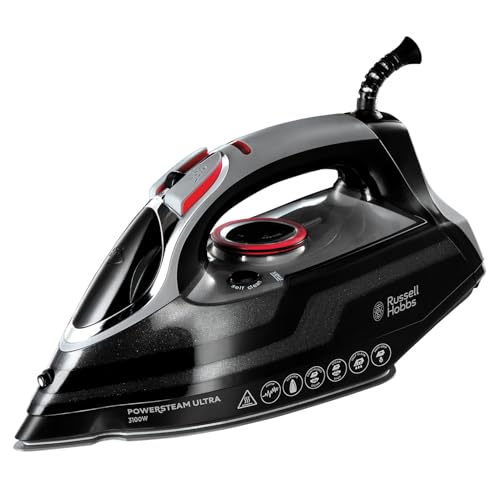
Best steam iron for creases
Russell Hobbs Powersteam Ultra 20630: Best steam iron for creases
- Power: 3100W
- Continuous steam: 70g/min (Russell Hobbs figure; Currys lists 45g/min)
- Steam shot: 210g/min
- Tank: 350ml
Its 210g/min steam shot is among the strongest on a corded iron, which is what a stubborn cotton crease needs, and the 350ml tank is large for a steam iron.
Before you start
- Check the care label. One dot on the iron symbol means 110°C maximum, two dots 150°C and three dots 200°C, according to the GINETEX care-label standard. Cotton chinos and jeans are usually three dots; wool and polyester-blend suit trousers are usually two. Our iron temperature settings guide has the full list.
- Empty the pockets. Keys and coins leave marks, and the pocket bags need to lie flat.
- Check for stains. Which? warns that ironing a stain can make it stick.
- Iron trousers slightly damp. Which? says creases are easiest to remove while clothes are still damp, so iron them from a short spin or mist them with water.
Step 1: pockets and waistband
Pull each front pocket inside out and press the pocket bag flat, then push it back in. Cleanipedia gives the same tip: turn the pockets out before ironing over the area. Left in, the outline of the pocket presses through to the outside of the leg.
Slip the waistband over the narrow end of the board, so only one layer of fabric sits on the board at a time. Press the waistband, the fly and the top few inches of the front, turning the trousers round the board as you go. Go round the buttons with the tip of the iron rather than over them.
Step 2: the seat and the top of the legs
With the trousers still over the end of the board, press the seat and the back pockets in short presses. Gentleman’s Gazette, which covers tailored trousers in detail, says to start with the waist and rise and to keep to small, lifted movements rather than dragging the iron across the cloth. If the trousers have pleats, press them from the waistband downwards so they lie the way they were sewn.
Step 3: line the legs up by the inseams
This step decides whether the crease ends up in the right place. Lay the trousers along the board with the hems at the pointed end. Lift the top leg out of the way, then fold the bottom leg so the inside leg seam lies directly on top of the outside leg seam. Art of Manliness describes the target well: one inseam should lie “dead center of the flat leg” on top of the other.
When the seams match at the hem and at the top of the leg, the front and back folds are exactly where the crease should go. Do one leg at a time; two layers of fabric trap steam and leave puckers.
Step 4: set the crease at the hem and at the top
Press the folded edge at the hem for a few seconds, which fixes the line at the bottom. Then press the fold at the top of the leg, stopping where the crease should end. Both ends are now marked and the middle only has to join them up.
On suit trousers the front crease runs from the hem to where the inside pocket bag ends, about 15cm below the waistband, which is lower than the pocket opening you see from outside. Art of Manliness suggests the same stopping point, the bottom of the inside pocket, and puts it plainly: “Don’t press the crease all the way up to the waistband.” On pleated trousers the crease runs into the bottom of the front pleat.
Step 5: press the crease along the leg
Working from the hem upwards, lower the iron onto the fold, hold it for two or three seconds, lift it and move it up by its own length. Overlap each press slightly. Do not push the iron along the crease: sliding stretches the cloth and, on wool, polishes it. A burst of steam on each press helps a stubborn cotton crease. On wool, Gentleman’s Gazette suggests a light mist of water instead of heavy steam, because steam trapped between layers causes puckering.
Then press the flat of the leg between the two folds, lifting as you go, so the leg is smooth without new lines.
Step 6: the back crease and the other leg
Turn the leg over without disturbing the seams and repeat Steps 4 and 5 on the back fold, which becomes the back crease. It should sit directly opposite the front crease. Then lay the second leg on the board, match its inseams the same way and press it to the same height.
Step 7: hang the trousers to cool
Hang the trousers straight away, by the hems on a clip hanger or folded along the creases over a bar hanger, and leave them until they are cool and dry. A crease sets as the fabric cools. Art of Manliness warns that wearing trousers while they are still damp works “the crease right back out”.
Where should the crease go? Suit trousers, chinos and jeans
The crease is a style choice as much as a pressing technique, and it changes with the fabric.
| Trousers | Crease | Where it runs | Setting (check the label) |
|---|---|---|---|
| Wool or wool-blend suit trousers | Sharp, front and back | Hem to the bottom of the pocket bag (see Step 4), or into the bottom of the pleat | Two dots, pressing cloth |
| Cotton chinos | Soft or none | If you want one, the same line as suit trousers, pressed more softly; many people press chinos flat | Three dots with steam |
| Jeans | None | Press flat along the seams; a crease on denim looks wrong and fades as a pale line | Three dots, inside out |
| Polyester or viscose dress trousers | Light | Same line as suit trousers, with less heat | One or two dots, pressing cloth |
Suit trousers are cut to hang from a crease, so they look wrong without one. Chinos were never designed around a crease, which is why a lot of people iron them flat with the seams lined up and skip Steps 4 and 5.
Wool trousers: use a pressing cloth
Wool shines when a hot soleplate sits on it, and the shine does not wash out. A pressing cloth, which is a clean white cotton tea towel or a square of plain cotton, goes between the iron and the trousers for every press on the right side of the cloth. Gentleman’s Gazette says a pressing cloth “will virtually eliminate the risk of shine”. Which? gives the same advice for any fabric that marks: turn it inside out or use a protective layer such as a clean cotton tea towel.
A slightly damp pressing cloth gives extra steam, which helps a tired crease.
Common mistakes
- Not matching the inseams. The crease ends up twisted round the leg.
- Pressing a double crease. If there is an old crease, line the new one up on top of it. Two parallel lines are very hard to remove.
- Taking the crease up to the waistband. It puckers at the pocket. Stop at the bottom of the pocket bag, as in Step 4.
- Sliding the iron along the crease. It stretches the leg and shines wool. Lower, hold, lift, move.
- Too much heat. Which? notes that a sheen on fabric is caused by excess heat. If the label says two dots, use two.
A board with a narrow, shaped end makes Steps 1 and 2 much easier: see best ironing boards. If you press suit trousers every week, a steam generator gives constant pressurised steam, which suits the lift-and-press method.
Frequently asked questions
Should trousers have a crease?
Suit trousers and formal wool trousers should, because they are cut to hang from one. Chinos can go either way, and jeans should not have one.
How far up should the crease go on trousers?
From the hem to the bottom of the inside pocket bag on the front (see Step 4), and to the same height on the back. On pleated trousers the crease runs into the bottom of the front pleat.
How do I get the crease in the right place?
Lay one leg on the board with the inside leg seam directly on top of the outside leg seam, at both the hem and the top of the leg. The folds this makes are where the creases go.
How do I iron wool trousers without making them shiny?
Use a two-dot setting, press through a cotton pressing cloth, and lift the iron between presses instead of sliding it.
Should I iron jeans?
Only to remove wash creases. Iron them inside out on a hot setting with steam, lying flat along the seams, with no centre crease.
Why does my crease drop out after an hour?
Usually because the trousers were worn while still warm or slightly damp. Hang them until they are cool and dry so the crease sets.
Related guides
- How to iron a shirt
- Iron temperature settings guide
- Best steam iron for shirts
- Best steam generator irons
- Best ironing boards
Sources: Which?: 10 ironing tips to get clothes looking their best; Which?: How to iron; Art of Manliness: How to Iron Trousers; Gentleman's Gazette: How to Iron Dress Pants; Cleanipedia (Unilever): Top ironing tips; GINETEX care-label standard: iron temperature dots. Prices change often, so check the latest price before you buy. How we research.

Leave a Reply